Selected Full Papers: CHI/UIST/ISMAR/SCF
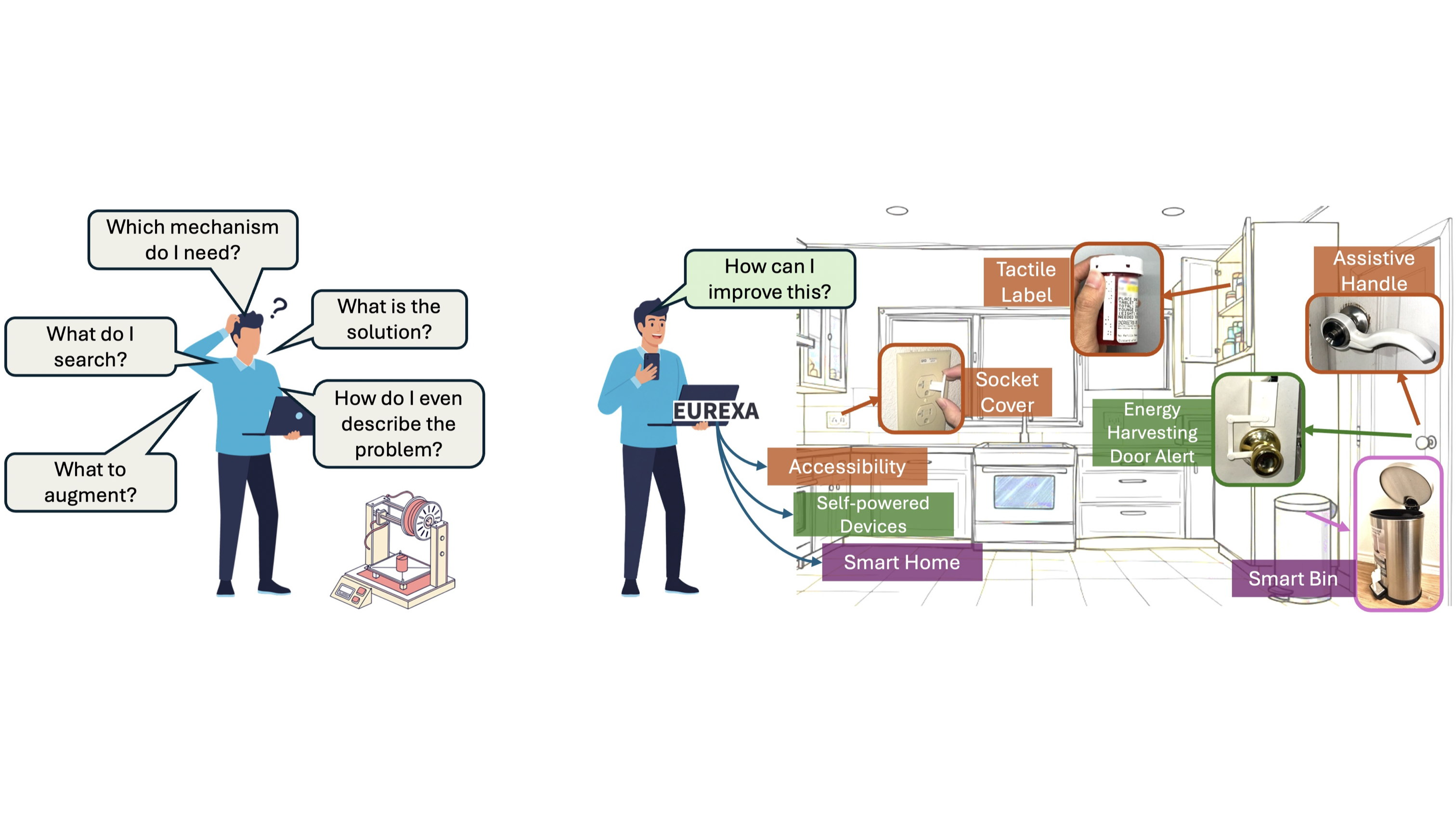
EUREXA: End-User Reconfiguration of Environment with eXplainable Augmentation for Generative Fabrication
In Proceedings of CHI '26 (ACM Conference on Human Factors in Computing Systems), Barcelona, Spain. April 13–17, 2026
Other Full Papers
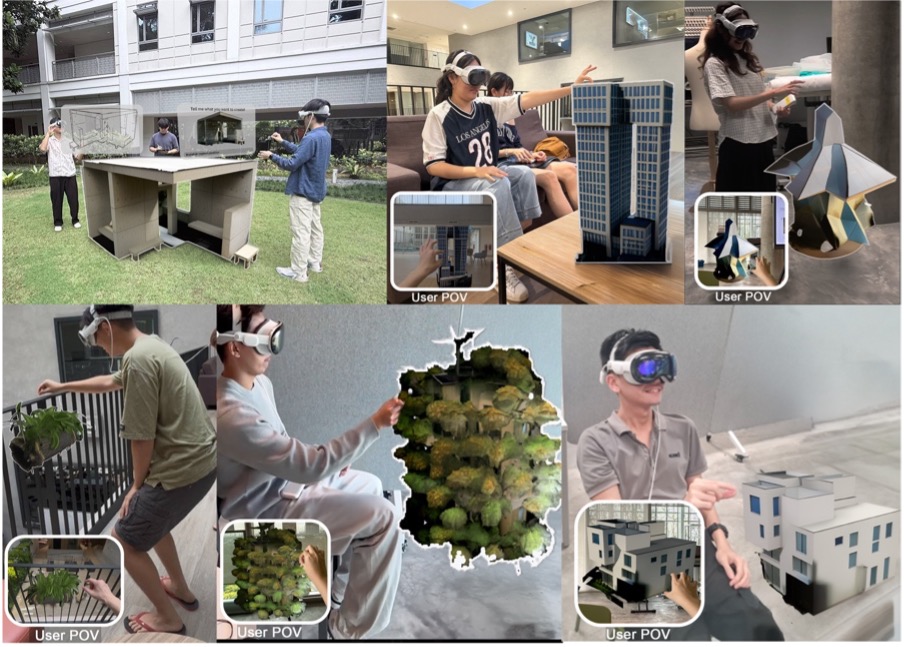
Development and User Evaluation of Multimodal Spatial Computing Applications for 3D Generative Workflows in Early-Stage Architectural Design Processes
In Proceedings of CAADRIA '26 (The Association for Computer-Aided Architectural Design Research in Asia), Hsinchu, Taiwan. April 26–May 2, 2026
Demos and Exhibitions
Coming Soon...
BibTeX
@inproceedings{eurexa2026arabi,
author = {Arabi, Abul Al and Cai, Charles Yushi and Lu, Ryann and Kong, Shu and Kim, Jeeeun},
title = {EUREXA: End-User Reconfiguration of Environment with eXplainable Augmentation for Generative Fabrication},
year = {2026},
isbn = {9798400722783},
publisher = {Association for Computing Machinery},
address = {New York, NY, USA},
url = {https://doi.org/10.1145/3772318.3791934},
doi = {10.1145/3772318.3791934},
abstract = {Augmentation allows rapid reconfiguration of passive physical interfaces to improve accessibility, support independent living through domestic automation, and more. However, its potential is largely unrealized for novice users due to several key barriers. First, users rarely identify latent interaction problems within their built environments. Second, they often lack the knowledge to clearly express design intent. Third, many innovative solutions remain in research prototypes, limiting access. We introduce EUREXA, an agentic AI system to share the spirit of discovery ("Eureka!"). EUREXA supports end-users through a diagnose–discover–describe workflow: from input with varying ambiguity and complexity, it surfaces latent interaction challenges, presents reconfiguration opportunities through augmentations, and produces interpretable designs. Its novelty is a dual search across public augmentation repositories and research articles, enabling reusable designs even when no design libraries or parametric tools exist. EUREXA transforms non-parametric models into parametric ones or directly generates fully explainable designs. To evaluate EUREXA across varied user inputs, complexities, and clarity levels, we define ambiguity metrics, conduct a user study, and report critical factors for advancing generative AI to help end-users readily augment physical interfaces through fabrication.},
booktitle = {Proceedings of the 2026 CHI Conference on Human Factors in Computing Systems},
articleno = {799},
numpages = {17},
keywords = {Agentic AI, Personal Fabrication, Generative design, 3D Printing.},
location = {Barcelona, Spain},
series = {CHI '26}
}